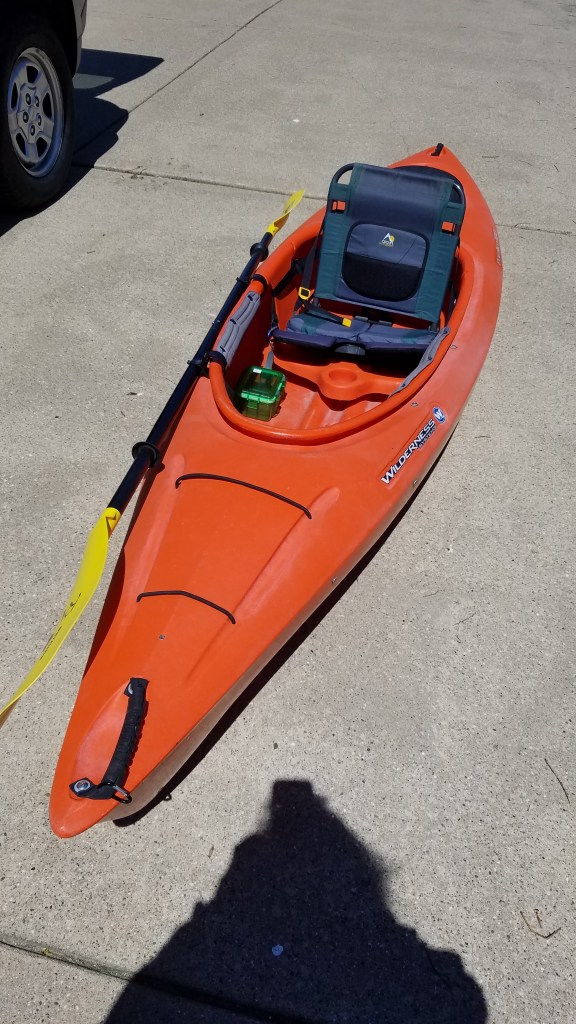
There are many decisions to make. Sit-inside or sit-on-top? Sit-inside has a lower center of gravity. Sit-on-top is easier to get in or get out and doesn’t fill with water as much as a sit-inside. Kayak length is a consideration. There are many different hull designs to choose from. If you are boating smaller waters, as is the case in southwest Michigan, then a eight to ten footer is for you. Shorter kayaks maneuver better in tight spots. Longer kayaks are better suited for large bodies of water such as Lake Michigan. Wide flat bottoms are more stable. Drain plugs at the tip of the bow or stern are handy. My own personal kayak is a Wilderness Pamlico 100, a ten footer. What works for me may not work for you. Choosing a kayak is a personal decision based on many considerations. There are different types of kayaks for different types of kayaking: touring, expedition, ocean & great lakes, and recreational. Sound complicated? I recommend a trip to a reputable kayak shop. A qualified salesperson can fit a kayak to your needs and body size. Body dimensions are very important in selecting a kayak. Don’t skimp on a paddle. A poorly designed and ill-fitting paddle can ruin a day on the water. A knowledgeable salesperson can fit a paddle to your height, your arm span, and the type of paddling that you intend to do.
Most kayak seats do not have much cushion. Nothing can be worse than getting a sore butt half way through a trip. A foam cushion or a inflatable cushion can save the day.
A waterproof container is a must-have for phone, wallet, keys, et cetera. They come in many shapes and sizes as well as hard and soft versions. Make sure you securely attach your container to the inside of your boat with a carabiner. You don’t want your valuables to float away if you tip over.
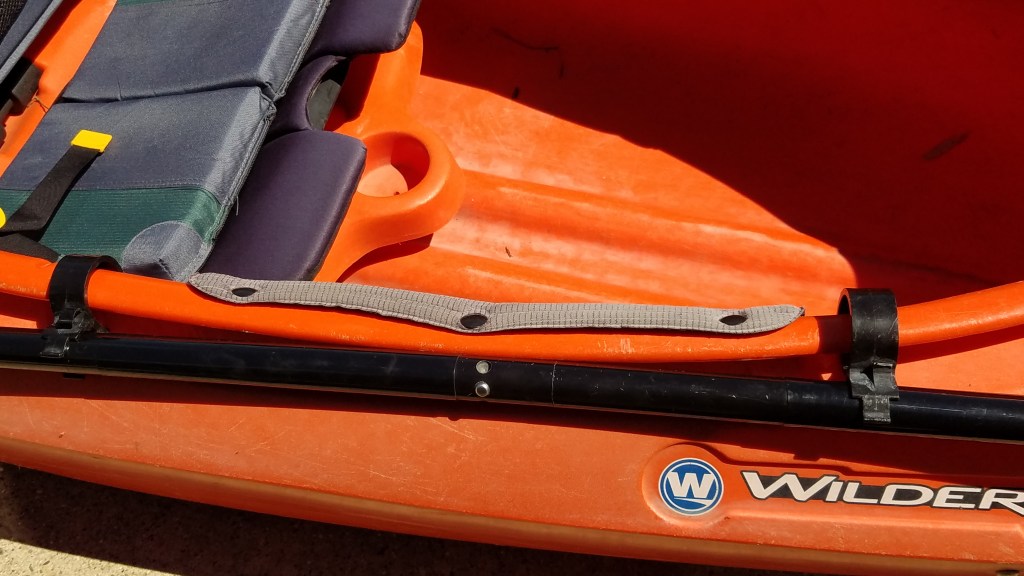
Nothing is more annoying than climbing into your boat and watching your paddle float off down the river. Paddle clips are the answer. One type attaches to the cockpit combing with no tools. Another type bolts to the deck and requires drilling holes in the deck.
A paddle tether will keep your paddle attached to your boat in case you become separated from it.
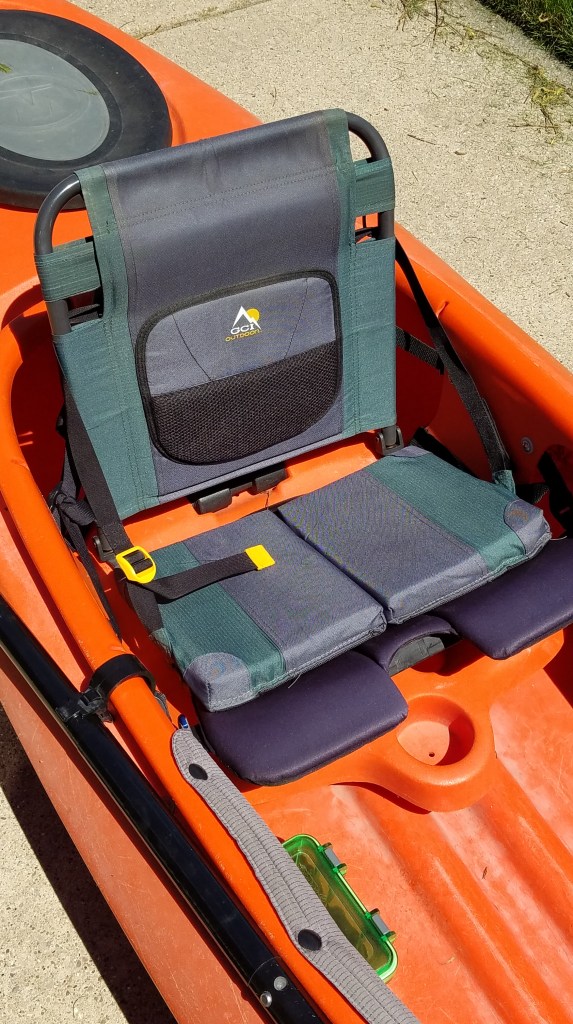
Seats in most kayaks have a short back. This lack of support can give a kayaker back pain. I remedied this situation by purchasing a seat intended for a canoe. It attaches to the kayak by straps and buckles. I find that my weight is enough to hold the seat in place so I don’t use the straps. The back of this seat is tall enough to give adequate back support and it folds flat for easy storage.
Unless the bottoms of your feet are like leather, you will need a pair of water shoes. An old pair of street shoes will work just fine but they take forever to dry. I recommend a pair of purpose-made water shoes. They can be purchased for as little as ten or fifteen dollars. High end models can go for as much as a hundred bucks. Water shoes with drain holes are great for letting water out, but they also let sand and gravel in. Don’t buy water shoes with a stiff sole that doesn’t bend. Even with minimal walking, these type of shoes will chafe your heels and give you painful blisters. I found out the hard way. Some of the primitive boat landings can be muddy, so plan accordingly.
No matter how hard you try, you are going to get your feet wet. This can be a problem if the water is uncomfortably cold. A pair of wet suit boots can be a valuable addition to your kayaking gear. I have never had cold feet while wearing wet suit boots.
A spray skirt is exactly what it sounds like. It fits around your waist like a skirt. The bottom of the skirt fits around your cockpit combing, effectively sealing the cockpit from water. In all the lakes and rivers I have kayaked in Michigan, I have not needed a spray skirt. I do recall a time when I was running a rapids on the Kalamazoo River between Otsego and Trowbridge Dam. It was one of the biggest rapids I have ever encountered. I don’t know how I made it through without tipping over. I like to think it was paddling skill but I’m sure that luck had a lot to do with it. Waves broke over my cockpit and I took on water. I had to stop on the river bank and drain my kayak before I could continue paddling. In my case, this is the only time a spray skirt would have come in handy. A spray skirt would also come in handy when launching your kayak in surf on one of the great lakes. Consulting an expert will help you decide if a spray skirt is a good choice for you.
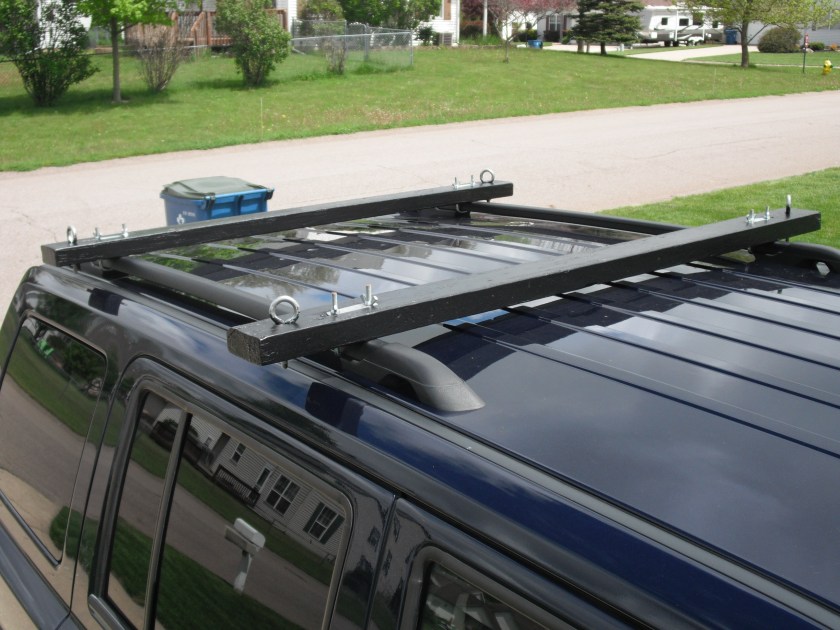
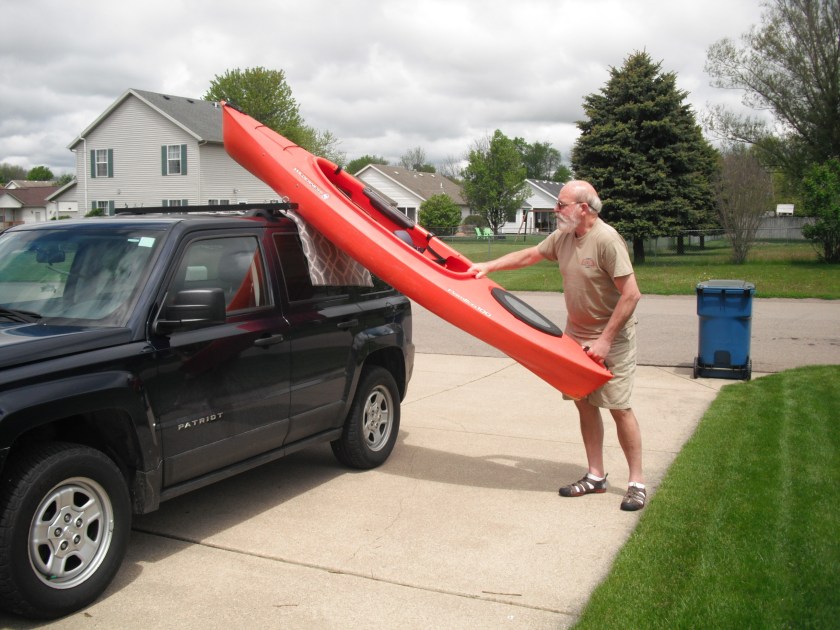
There are many different kinds of loading and hauling systems made for all kinds of vehicles. It is important to match the system to your physical ability. If your system requires two people to load and secure your kayak, then you won’t be able to take a kayaking trip by yourself. Here are some helpful tips on loading and hauling. Cheap DIY roof racks: 2 x 4, U-bolts, eye-bolts, paint.
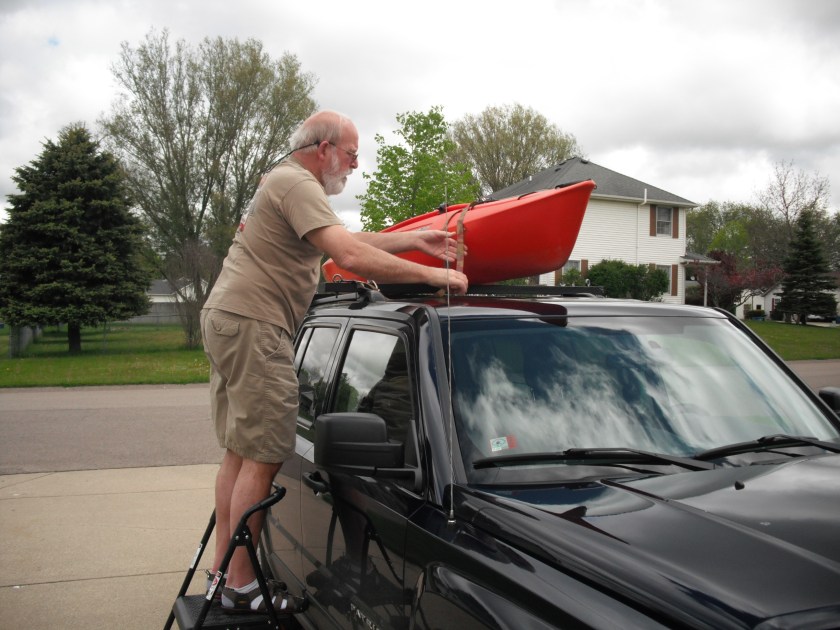
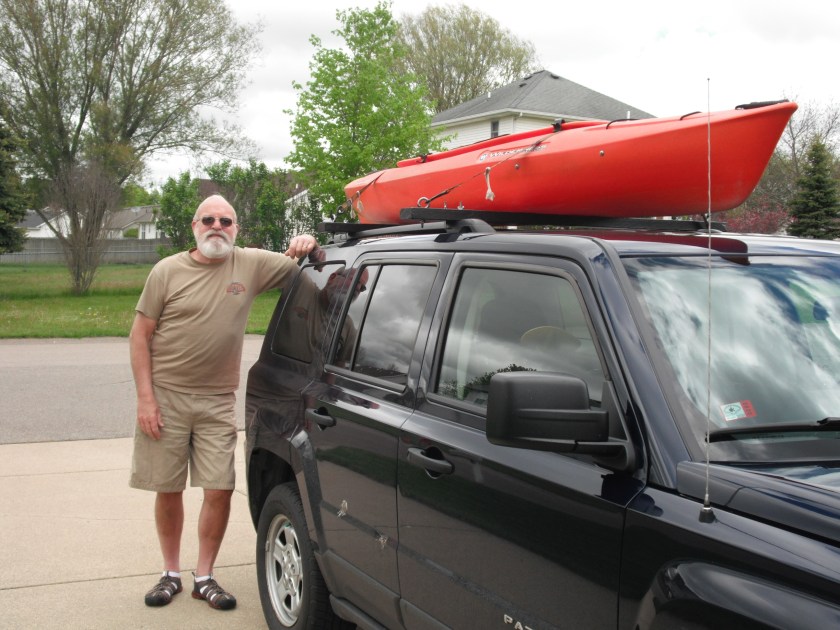
The loading and hauling system that I use allows me to easily load and secure my kayak by myself:
A small ladder eliminates slipping off a rocker panel or a bumper while strapping down your kayak. I have had too many close calls before I wised up and bought a two foot ladder. I take it with me on every trip.
Ratchet straps are the easiest way to secure a kayak.
Note the short pieces of clothesline rope tied to the ratchet straps. They eliminate vibration and noise.
When moving your kayak during a portage or at a boat landing, don’t drag it. Always carry it. Dragging will wear a hole in your hull. My kayak sports a kevlar patch on the stern due to my beginner ignorance.
This post contains information that applies to all waters and will further your kayaking enjoyment. The info is in four sections. The first is “Kayaking And Plants”. You may think that plants have nothing to do with kayaking. In many instances, certain plants can turn a fun trip into a unenjoyable chore. “Kayaking And Birds” will tell you what to expect from our feathered friends. The information in “Kayaking And Obstacles” applies to beaver dams, logs, branches, rocks, and trees. The fourth section is “River Paddling Tips”. I find that constantly learning new kayaking skills and acquiring new information allows me to have more fun on the water. Fun is the name of the game!
KAYAKING AND PLANTS
There is a aquatic plant called water willow or swamp loosestrife. It grows along the shores of some lakes and small streams. Its slender stem bends over and the tip roots, forming a loop. Try not to let your kayak or your paddle enter the loop. The roots will pull out and smear you and your kayak with mud.
Poison Ivy. I mention this for obvious reasons. If you must be on the river bank or the lake shore, learn to positively identify this pest.
While surfing satellite photos on Google Maps for possible kayaking spots, I noticed a small stream connecting Upper and Lower Jeptha Lakes in VanBuren County. I decided to go there and explore. I paddled up the small stream and it kept getting narrower. At times, it was barely wide enough for my boat. I paddled on and blundered into a patch of what appeared to be wild roses, complete with thorns. The thorns thoroughly scratched me, drawing blood. It was a hot day and my sweat caused the scratches to sting. I painstakingly paddled myself from the thorny bushes and beat a hasty retreat. Since then, I have encountered this plant while kayaking other waters only with better results. Please learn from my misfortune.
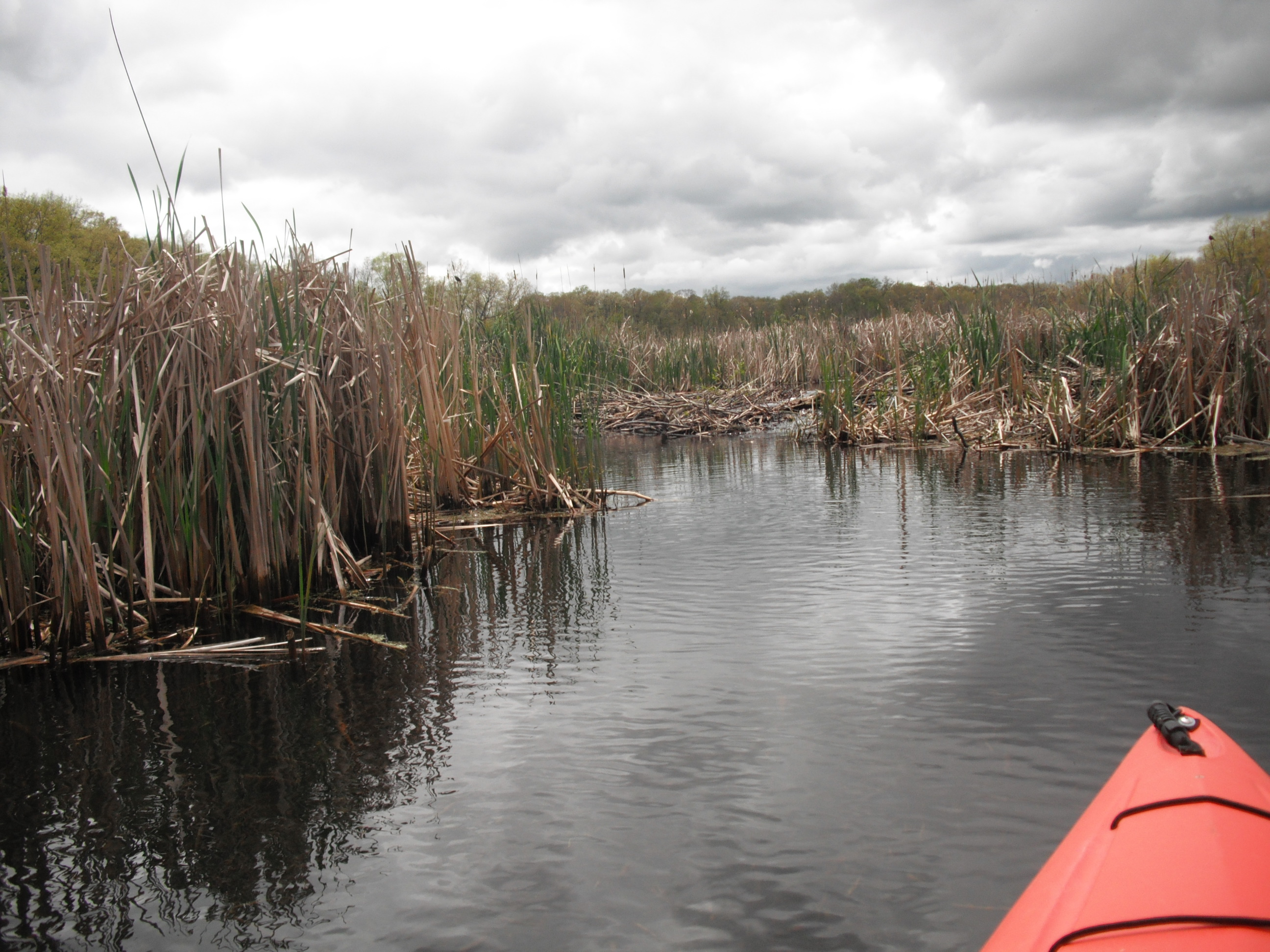
Many waterways in southwest Michigan are bordered by cattails. Some lakes and rivers have vast areas of cattails. Small, narrow streams meander through cattail marshes. Sometimes, small clumps of cattails, roots and all, will break away from the cattail bed. These small floating cattail islands travel downstream and collect at bends and narrow spots, making what appears to be a dead end. You can look for a alternate route, but there usually isn’t any. Look carefully at the surface of the stream and follow the strongest part of the current. The signs of current may be barely visible. The spot where the strongest current enters the dead end is where you must force your way through. You may have to try several spots before you find one that works. This strong-arm technique really works. I have had 100% success by using this strategy. Many months after I wrote this, my kayaking friend, Dan, and I encountered a situation where we couldn’t force our way through a cattail island jam. The trip turned ugly in a hurry. While seated in our kayaks, we grabbed the cattail stalks and pulled our kayaks over the floating islands by hand. It was tough, time consuming work. Kayaking isn’t always easy!
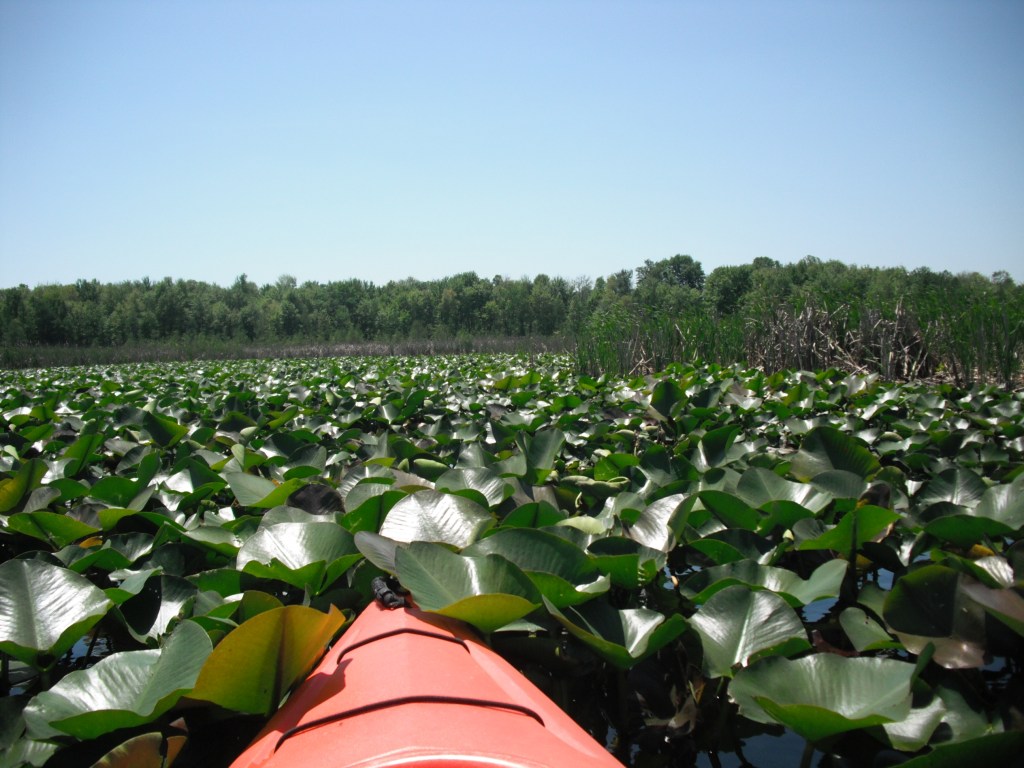
Lily Pads. For the sake of simplicity, let’s just say that there are two types of lily pads. One type has pads that lay flat on the surface of the water. These are relatively easy to paddle through. The other type has pads that stick up out of the water, up in the air by a foot or more. These pads are difficult to paddle through.
Thick stands of these pads can be impassable. They are also host to many insects and spiders that like to make your kayak their home. In my upcoming destinations section, I will note these waters and save you some grief.
KAYAKING AND BIRDS
The majority of birds you encounter will be waterfowl. Ducks usually stay away from paddlers. Sometime they will sit tight to cover and explode into the air when you are right on top of them. Geese will do the same thing but they will usually keep their distance. Geese can be quite vocal. Herons like to build a bunch of nests in a single tree. If you paddle close to one of these rookeries, the herons will make quite a racket but that’s about it. Sandhill Cranes are frequently seen but are usually shy. I have never seen Trumpeter Swans while kayaking southwest Michigan. All the swans I see are Mute Swans, an invasive species. Mute Swans destroy aquatic habitat. They are unpredictable. Sometimes they will stay away and other times they will get uncomfortably close. They can be very aggressive but I have never been attacked by one. Due to their size and unpredictability, be cautious around these swans. Overall, most waterfowl will become somewhat aggressive to protect their nests and young.
I came across these Mute Swans with four cygnets while paddling a unnamed stream, Gull Creek watershed, Kalamazoo county.
KAYAKING AND OBSTACLES
BEAVER DAMS, LOGS, BRANCHES, ROCKS, and TREES
If you kayak small streams in southwest Michigan, sooner or later you will encounter beaver dams. All the beaver dams I have run into were in cattail marshes. Because of the nature of the marsh, it is not possible to portage around the dam. You must go over it. If you are approaching from downstream and the stream is wide enough, position your boat parallel to the dam. While seated, swing both legs over the same side of the boat, facing the dam. Probe the submerged portion of the dam with your feet until you find adequate footing. Gradually put weight on your feet until you can stand up without breaking through the branches that make up the dam. You are now ready to drag your kayak over the dam and continue paddling. If the stream is too narrow, position your boat perpendicular to the dam. While seated, put a leg over each side of your boat and slide down the foredeck to the bow. Once you are there, you can probe with your feet, gradually stand up, pull your boat over, and paddle on.
Approaching a beaver dam on a unnamed stream, Gull Creek watershed, Kalamazoo county.
When approaching from upstream, the best strategy is simply to go fast and slide over. This also applies to obstacles besides beaver dams. Most times you can get at least halfway over if not all the way over. If you don’t make it all the way over, you can get out and drag your kayak over or you can stay in your kayak. You may find yourself in a similar situation while river or lake paddling when you are sitting on top of a tree, rock, or log. While seated in your kayak, use inertia to “scoot” off the object. It is the same technique you use when you are sitting in a chair and “scoot” it up to the dinner table. Move your upper body forward, bending at the waist. Stop suddenly and your kayak will move forward. It may take many tries to slide off that dam, rock, or log but sometimes “scooting” is your only option. You can try paddling off the object but you will find that your bow will move side to side, back and forth, with no forward progress. You can try using your paddle as a push-pole but you run the risk of breaking your paddle. I have successfully used “scooting” more times than I can count. When you slide off an object that is high up off the water like a beaver dam or log, that nice wide stable middle portion of your kayak will not have much contact with the water. The narrow bow and stern will momentarily carry all the weight and your kayak will get tippy. Be careful not to lose your balance or you could tip over. You may encounter a submerged beaver dam or one that is submerged and partly exposed. This is caused by a new dam that the beaver built downstream, flooding the old dam. It’s usually easy to paddle over these dams. I carry a small hand garden cultivator in my boat when I am traveling waterways that beavers inhabit. The tines of the cultivator make short work of removing parts of a submerged dam that are blocking your way and you don’t even have to get out of your boat. I have noted the waters that have beaver dams. I try to keep that information current, but sometimes beaver dams can spring up without my knowledge.
RIVER PADDLING TIPS
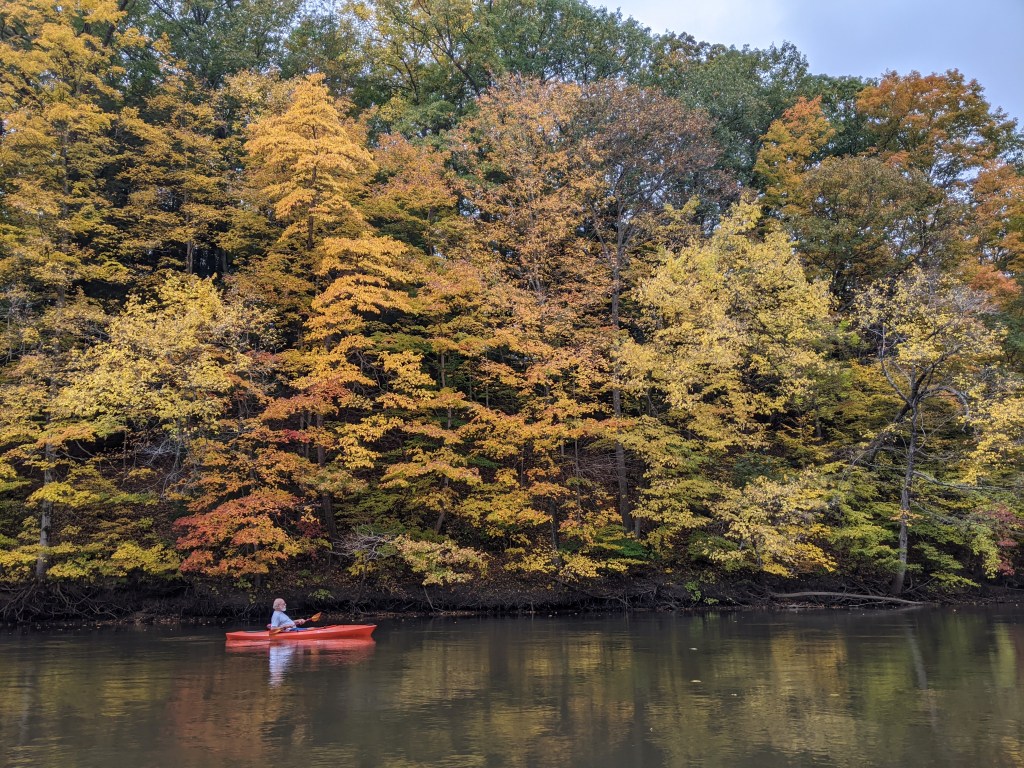
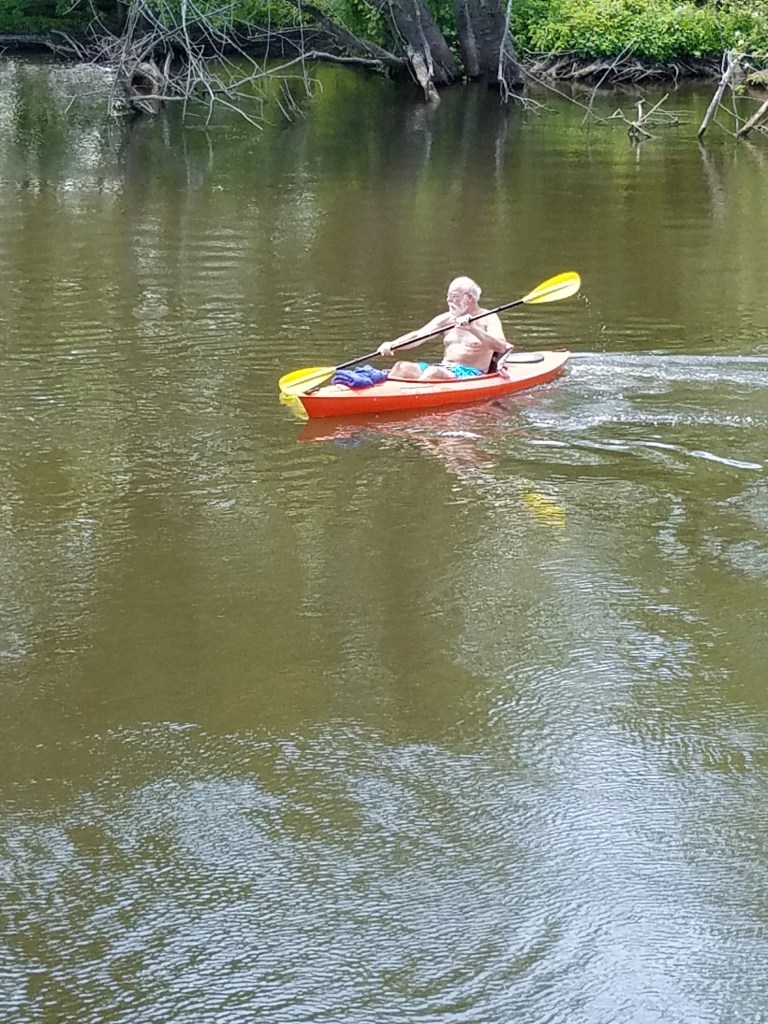
Ron, enjoying an afternoon on the Kalamazoo River.
In order to have a safe and enjoyable river trip, keep your boat in position to negotiate river bends, shallow water, and obstacles like trees, logs, rocks, and branches. Don’t wait until the last second. It is important to position your boat ahead of time. Current will push your kayak towards the outside of bends where trees and branches accumulate. Position your boat on the inside of the bend and you will avoid trouble. Keep an eye out for shallow water on the inside of bends. Many kayakers approach obstacles way too fast. Slow down. Paddle backwards if you have to. Several tight maneuvers in small spaces are much easier to accomplish at slow speeds. Tight turns can be made by paddling forward on one side of the boat and backwards on the opposite side. Sometimes, you can use your paddle as a rudder to avoid obstacles. If you do get stuck on an obstacle and the water is too deep to get out of your kayak, then use the “scooting” method that I mentioned earlier. This technique is similar to sitting in a chair and “scooting” it up to the dinner table. Sometimes, if the water is shallow, it’s easier to get out of your kayak and drag it over. Getting stuck on an object, even a very small one, can make your boat tippy, so use caution and maintain your balance.

 KAYAKING SOUTHWEST MICHIGAN