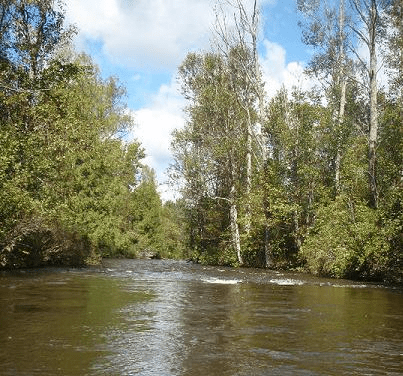
The Sturgeon River is the fastest flowing river in Michigan’s lower peninsula and also the most difficult for kayakers. It has the steepest gradient, dropping an average of fourteen feet per mile of river. That translates to a two hundred and ten foot drop during the length of my trip! This portion of the Sturgeon is noted for its sections of class I and II rapids, whitewater, standing waves, and a couple of three foot drops. There are many hairpin turns as well. Obstacles include the usual trees, logs, branches, and rocks. This stretch of the river varies in width from thirty to fifty feet, with a few spots that are narrower. I kayaked the river in early September and I never saw another boater.
The Sturgeon River, between Wolverine and Indian River, is not suitable for beginners or inexperienced paddlers. I am still amazed that I conquered it without tipping over. My kayaking resume’ includes almost every river in southwest Michigan and those waterways were invaluable in preparing me for the Sturgeon. Experience and boat position are the keys to successfully paddling this river. As soon as you negotiate one obstacle, get in position for the next one or two obstacles. Always plan ahead. Never wait until the last minute. In rapids and whitewater, my experience helped me to instinctively react to the situations. I didn’t have to think about what to do. It came to me automatically. If you have to think about it, then it’s too late. This stretch of the Sturgeon River can be dangerous for beginners and inexperienced kayakers. The strong current shows no mercy. There’s always the possibility of injury if you don’t know what you’re doing. Be alert, observant, and ready at all times! Position!!!
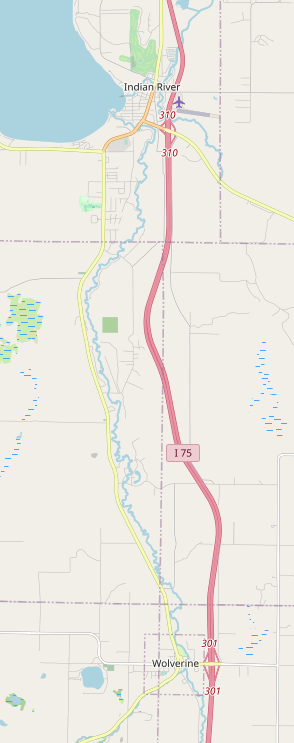
The paddling portion of my excursion started in the village of Wolverine, but my trip began at a watercraft livery in the village of Indian River. The owner of the business gave me a briefing about the river. The information that she gave me was instrumental to my success. At one point, she instructed me on what to do WHEN I tipped over, not IF I tipped over. What a confidence builder!
The livery provided transportation for me and my kayak to the launch site in Wolverine. The driver gave me some tips that were very helpful. There were two other kayakers riding with us. They were taking a shorter trip, so we were dropping them off first. We drove across a bridge over the Sturgeon to get to their launch site. From the bridge, I got a good look at the river for the first time. All I saw in both directions were rapids. My confidence was eroding further with every passing minute. We arrived at the launch site in a park on the north side of the village of Wolverine. The driver wished me good luck and drove off. I was on my own with fifteen miles of river in front of me.
I was still a little nervous when I shoved off from the landing. Within the first half mile, I encountered my first rapids with standing waves. After successfully paddling that stretch, I felt ready for whatever the river would throw at me. A little success gave my spirits a big boost!
The river corridor is mostly forested with a few sections of open country. In some places, cedar trees lined the river banks, some leaning over the river at odd angles. Enjoying the strong aroma of the cedars while paddling a scenic river is what kayaking is all about! Sometimes, it’s hard to enjoy the scenery because paddling demands most of your attention.
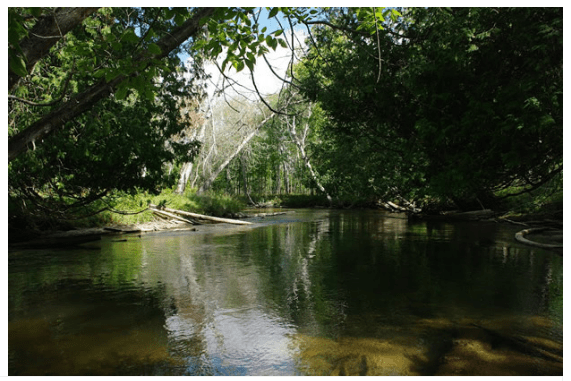
There are very few homes on the banks of the Sturgeon until you get to the village of Indian River. There are a few roads that cross over this stretch of the river and they are, from south to north, Scott Road, Rondo Road, South and North White Road, and highway M68. There is a state forest campground named Haakwood on the west side of the river, on South Straits Highway, between Scott Road and Rondo Road.
I can’t possibly recount every mile of my voyage, but I can tell you a couple of stories that are representative of what you may encounter when kayaking the Sturgeon.
About halfway through my trip, I rounded a hairpin turn and was greeted by two fallen trees blocking the river. I immediately paddled backward and slowed to a crawl, out of the strong main current. The tangle of tree trunks, limbs, and roots looked impassable. The current had created a scour hole under the trees, so getting out of my kayak and wading it through was not an option. The shore was thick with vegetation, so a portage was out of the question. I picked a likely spot and slowly drifted into the tangle. I didn’t go very far before the current pushed and pinned me against the base of a tree. My kayak began to tip. If it filled with water while pinned against the tree, my trip would be over. I couldn’t use my paddle because of all the tree branches, so I stuck it in my cockpit. I inched myself forward by grabbing branches and pulling my kayak ahead by hand. I pulled myself over, under, and through the trees until I was finally able to paddle my way clear of the tangle. It was very slow going and it seemed to take forever to get through. I was happy to leave those trees behind me!
A while later, I was paddling a short, straight section of the river when I spotted a good sized log blocking the river from bank to bank, with water flowing over the middle of it. I decided to speed up and slide over it. When I got to the point of no return, I saw that there was only a little water flowing over the log. There was a drop-off of over a foot on the downstream side of it. I slid about half way over the log and came to a stop. I was sitting on top of it with the front half of my kayak out of the water by a foot. The water looked deep. Because of my age, my agility had left me, along with my youth. Getting out of my kayak while on top of the log was not an option. I decided to use inertia to “scoot” my kayak the rest of the way over the log. It’s just like sitting in a chair and “scooting” it up to the dinner table. It works for me all the time. I “scooted” a few inches at a time and my kayak finally started to slide over the log. As soon as my bow hit the water, a eddy current pulled it towards the log while the stern was still on top of the log. When the stern fell off the log, it was pulled up to the log too. I found myself up against the log, parallel to it. My kayak began to wobble side to side, back and forth, threatening to tip over. I grabbed the log with one hand and the wobbling stopped. How I didn’t tip over was beyond me! What next? The only way out that I could think of was to push off the log and hope for the best. I braced myself for the rush of cold water that happens when you tip over. I gave a good strong push-off from the log and I floated gently downstream, right side up! The outcome was much better than I expected!
These are just a couple of the many challenges that faced me on the Sturgeon.
My trip was nearing the end when I approached the village of Indian River. The current gradually slowed and the obstacles were fewer in number. I could relax and enjoy a beer, instead of grabbing a hurried slug here and there. Soon, I was paddling along the backyards of homes in a residential area of the village. I passed under the M68 bridge and entered Burt Lake State Park. Downstream from the bridge, there is a sturdy dock at the base of a steep hill on the left bank of the river. A set of stairs with a canoe/kayak slide next to it leads from the dock to the top of the hill. You will appreciate the slide after a long day on the water. The parking area at the top of the hill is just for loading and unloading. Longer term parking is nearby.
I was tired after I loaded up my kayak and gear , but it was a good tired. I had successfully kayaked the most difficult river in the lower peninsula and the feeling was rewarding, almost euphoric. You will know that feeling when you complete this voyage! Good Luck!

 KAYAKING SOUTHWEST MICHIGAN