The city of Cheboygan is a port on the shore of northern Lake Huron, fourteen miles southeast of Mackinaw City and the Mackinaw Bridge. The city is serviced by highway US23. The thirty four square mile Bois Blanc Island is north of Cheboygan, separated from the mainland by the South Channel of the Straits of Mackinaw. East of Cheboygan, there is a portion of Lake Huron called Duncan Bay, where this voyage takes place. Duncan Bay is accessed from Cheboygan State Park.
The entrance to Cheboygan State Park is on the north side of US23, two and one half miles east of the Cheboygan city limits. Follow the park signs to the campground. A short trail between two campsites leads to the Duncan Bay access.
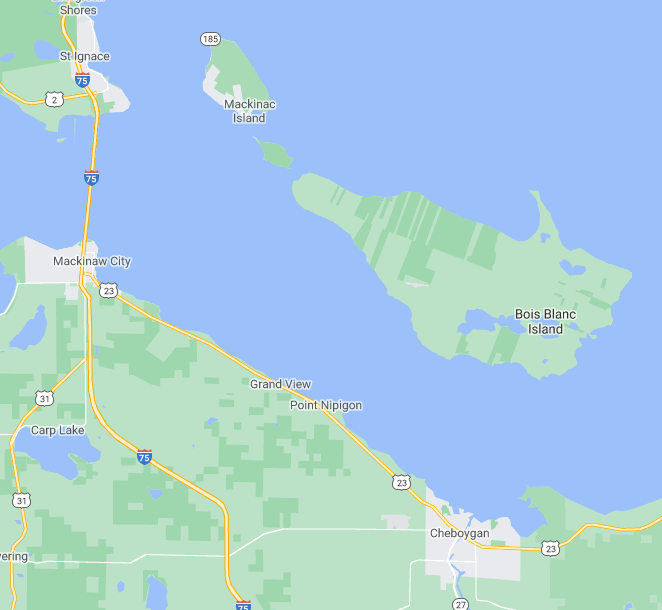
Duncan Bay is protected from winds coming from every direction but northwest. Unfortunately, on the day of my adventure, the wind was whipping from the northwest. The marine forecast had predicted it. I decided to go to the state park boat landing for a look-see. Upon observation, the conditions on Duncan Bay looked safe enough to paddle, despite the big waves. I would be paddling northwest, toward rougher water. I didn’t want to leave without giving it a try. Besides, quitting is for sissies.
The near-shore area of the crescent shaped east side of Duncan Bay is lined with reeds. My first objective was a unnamed point, a half mile northwest from the boat landing. I used the reeds to my advantage as I pulled away from shore. I stayed on the lee side of the thickest stands of reeds that I could find, while still maintaining my northwest course. The thick reeds dampened the waves, enough to make a difference. The reeds thinned out as I approached the point. I was exposed to the wind and waves for a little while, then the point offered me some protection from the adverse conditions.
I beached my kayak on the gravel point and got out to assess the situation. To the north, the wind was stronger and the white-capped waves were larger than they were in the area that I had just paddled. My next objective, Cheboygan Point, was a half mile away to the northwest, separated from my present position by a shallow bay. My initial reaction was to turn around and go back. After studying the waters and the coastline for a while, I decided that the conditions were not as bad as I first thought.
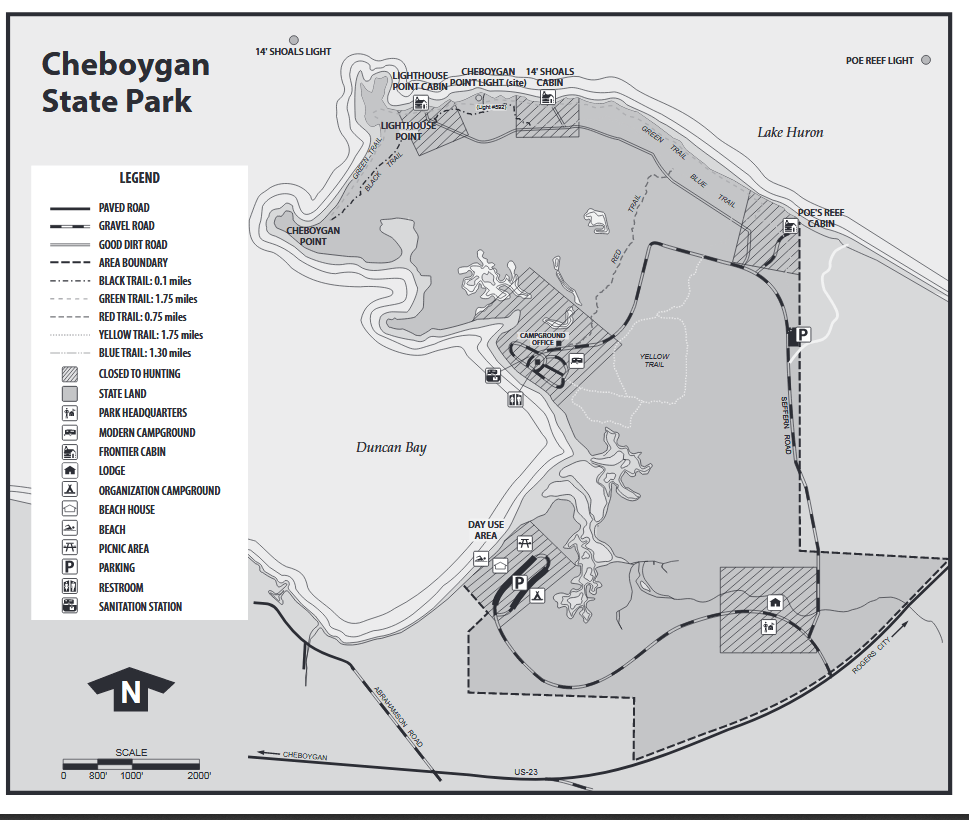
My strategy was to head straight north across the wind-swept waters of the bay and follow the shoreline west to Cheboygan Point. I would have to paddle broadside to the waves in the bay. I have experienced kayaking under similar conditions. I was able to establish a paddling rhythm that matched the rhythm of the waves. I safely crossed the bay without incident. I paddled west, as tight to shore as I could get without running aground. I was still feeling the wind and the waves, but it wasn’t as bad as the offshore waters.
Upon reaching Cheboygan Point, I beached my kayak and got out for a stretch and a beer break. The view from the point was nothing short of amazing! I felt the full force of that northwest wind and it was blowing furiously. The large, white-capped waves roared down the South Channel towards me. I could see all of Duncan Bay to the south and the city of Cheboygan to the southwest. To the northwest, Mackinaw Bridge appeared on the horizon. The large expanse of Bois Blanc Island filled my view to the north. Also to the north, on the mainland, I could see Lighthouse Point. Beyond Lighthouse Point, Fourteen Foot Shoal Lighthouse was perched on a offshore reef. I was mesmerized by the view.
Lighthouse Point, another half mile to the north, was my next objective. The lake conditions between Cheboygan Point and Lighthouse Point were much worse than the conditions on the previous part of my voyage. After considerable thought, I decided that the rough seas and the high winds were too much for me and my kayak. The lake finally won. It was time to head back to the landing.
Instead of retracing my previous course, I decided to cut straight across Duncan Bay, from Cheboygan Point directly to the boat landing. The wind and waves would be at my back for this leg of the voyage and my previous kayaking experience under similar conditions made it a good choice. You may think that paddling downwind with large waves is dangerous. It is actually quite safe and fun! When a big wave approaches you from behind, it looks like it’s going to wash over your boat. Just when you think all seems lost, the wave will pick up the stern of your boat and propel you forward, briefly surfing until the wave passes you. Your kayak will settle into the trough between the waves and you wait for the next wave to propel you forward. There is very little waiting because the waves are very close together. I used this technique on the one mile trip back to the landing and it was exhilarating!
If you are going to kayak the waters of Duncan Bay and Lake Huron at Cheboygan State Park, I hope you have better lake conditions than I did. I really wanted to reach Lighthouse Point and the coastline beyond, but the reality of high winds and rough seas kept me in check. I was not disappointed and my trip exceeded my expectations. I highly recommend kayaking this small part of Lake Huron. Have a safe trip and enjoy the scenic views!

 KAYAKING SOUTHWEST MICHIGAN